


 Goto chatroom
 Terms
Terms
 Privacy
Unveiling the Growth Dynamics of the Directional Drilling Market
https://www.marketresearchfuture.com/reports/directional-drilling-market-1375
The global Directional Drilling Market Growth
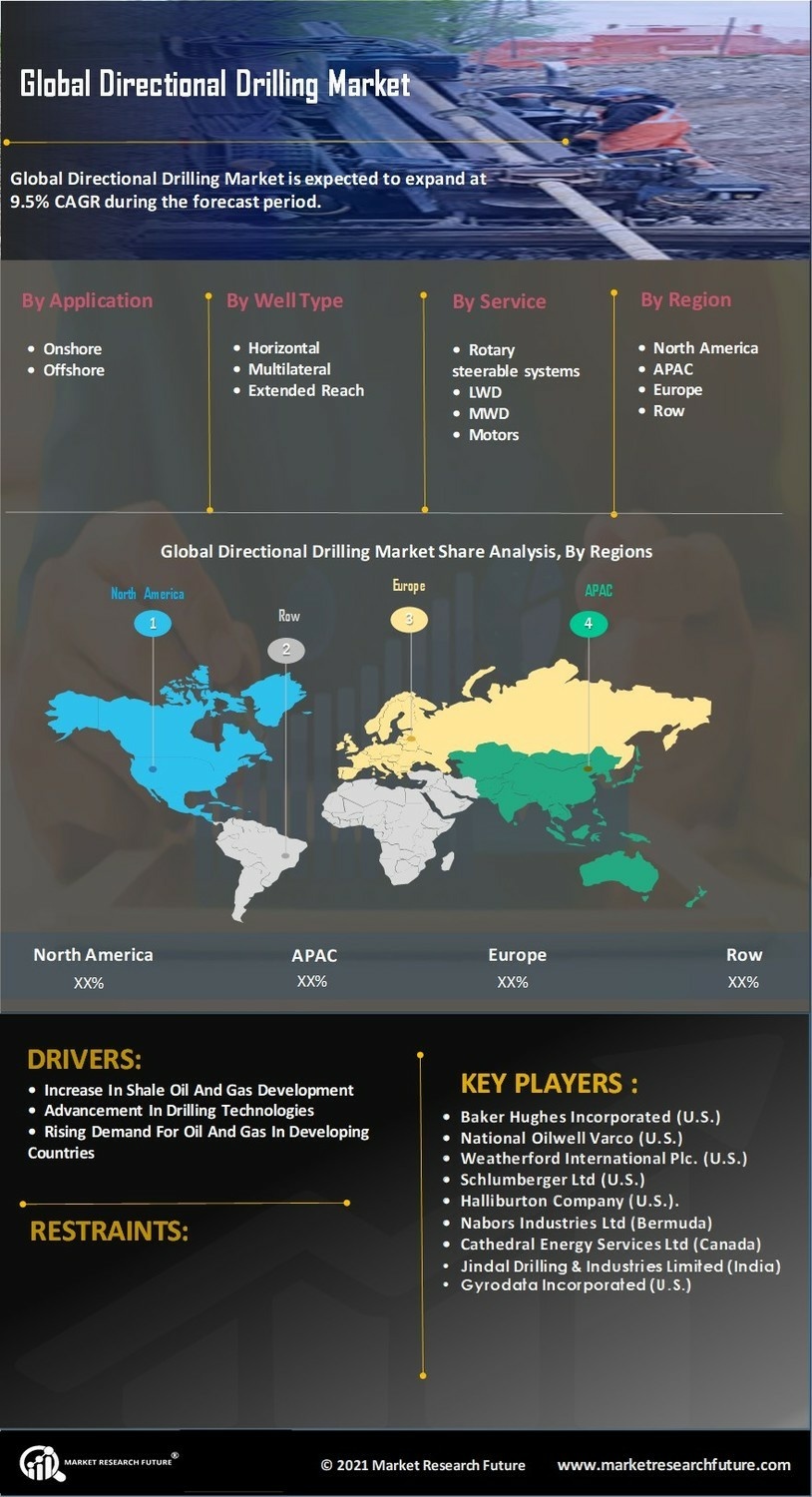
has gained remarkable momentum over recent years, driven by the increasing demand for efficient oil and gas extraction technologies. Directional drilling, a technique that allows drilling at multiple angles rather than just vertically, has become a cornerstone in maximizing hydrocarbon recovery and optimizing production costs. This innovative drilling method has transformed the energy industry by enabling access to complex reservoirs and extending the lifespan of existing oil wells.
Rising Demand for Energy and Technological Advancements Driving Market Growth
The steady rise in global energy consumption is one of the primary factors fueling the growth of the directional drilling market. As conventional oil reserves become harder to access, oil and gas operators are increasingly turning toward unconventional drilling methods to tap into previously unreachable reserves. Directional drilling facilitates precise targeting of reservoirs, minimizes environmental disruption, and enhances overall drilling efficiency.
Moreover, advancements in drilling technologies such as rotary steerable systems (RSS), 3D visualization tools, and advanced measurement-while-drilling (MWD) and logging-while-drilling (LWD) systems have revolutionized the accuracy and performance of directional drilling operations. These innovations enable real-time monitoring, allowing drillers to make quick adjustments during the process, which improves accuracy and reduces operational costs.
Automation and digital transformation have further accelerated market growth. AI-driven analytics, predictive maintenance, and remote monitoring systems are helping companies reduce downtime and optimize drilling performance. The integration of these technologies ensures higher success rates in horizontal and extended-reach drilling, which are becoming increasingly popular in both onshore and offshore projects.
Growing Exploration in Unconventional Resources
The expansion of shale gas and tight oil exploration activities, particularly in regions like North America, is another significant driver of the market. The United States has witnessed a major boom in shale drilling, thanks to horizontal drilling combined with hydraulic fracturing. These techniques have unlocked vast reserves of oil and gas, positioning the U.S. as a global leader in energy production.
In addition, the increasing number of deepwater and ultra-deepwater projects is further propelling the demand for directional drilling services. Offshore exploration requires precise well placement and enhanced control—factors that directional drilling technologies are uniquely capable of providing. As countries across Asia-Pacific, Africa, and South America ramp up offshore exploration, the market is set to witness continued expansion.
https://www.marketresearchfuture.com/reports/directional-drilling-market-1375
The global Directional Drilling Market Growth
has gained remarkable momentum over recent years, driven by the increasing demand for efficient oil and gas extraction technologies. Directional drilling, a technique that allows drilling at multiple angles rather than just vertically, has become a cornerstone in maximizing hydrocarbon recovery and optimizing production costs. This innovative drilling method has transformed the energy industry by enabling access to complex reservoirs and extending the lifespan of existing oil wells.
Rising Demand for Energy and Technological Advancements Driving Market Growth
The steady rise in global energy consumption is one of the primary factors fueling the growth of the directional drilling market. As conventional oil reserves become harder to access, oil and gas operators are increasingly turning toward unconventional drilling methods to tap into previously unreachable reserves. Directional drilling facilitates precise targeting of reservoirs, minimizes environmental disruption, and enhances overall drilling efficiency.
Moreover, advancements in drilling technologies such as rotary steerable systems (RSS), 3D visualization tools, and advanced measurement-while-drilling (MWD) and logging-while-drilling (LWD) systems have revolutionized the accuracy and performance of directional drilling operations. These innovations enable real-time monitoring, allowing drillers to make quick adjustments during the process, which improves accuracy and reduces operational costs.
Automation and digital transformation have further accelerated market growth. AI-driven analytics, predictive maintenance, and remote monitoring systems are helping companies reduce downtime and optimize drilling performance. The integration of these technologies ensures higher success rates in horizontal and extended-reach drilling, which are becoming increasingly popular in both onshore and offshore projects.
Growing Exploration in Unconventional Resources
The expansion of shale gas and tight oil exploration activities, particularly in regions like North America, is another significant driver of the market. The United States has witnessed a major boom in shale drilling, thanks to horizontal drilling combined with hydraulic fracturing. These techniques have unlocked vast reserves of oil and gas, positioning the U.S. as a global leader in energy production.
In addition, the increasing number of deepwater and ultra-deepwater projects is further propelling the demand for directional drilling services. Offshore exploration requires precise well placement and enhanced control—factors that directional drilling technologies are uniquely capable of providing. As countries across Asia-Pacific, Africa, and South America ramp up offshore exploration, the market is set to witness continued expansion.
Unveiling the Growth Dynamics of the Directional Drilling Market
https://www.marketresearchfuture.com/reports/directional-drilling-market-1375
The global Directional Drilling Market Growth
has gained remarkable momentum over recent years, driven by the increasing demand for efficient oil and gas extraction technologies. Directional drilling, a technique that allows drilling at multiple angles rather than just vertically, has become a cornerstone in maximizing hydrocarbon recovery and optimizing production costs. This innovative drilling method has transformed the energy industry by enabling access to complex reservoirs and extending the lifespan of existing oil wells.
Rising Demand for Energy and Technological Advancements Driving Market Growth
The steady rise in global energy consumption is one of the primary factors fueling the growth of the directional drilling market. As conventional oil reserves become harder to access, oil and gas operators are increasingly turning toward unconventional drilling methods to tap into previously unreachable reserves. Directional drilling facilitates precise targeting of reservoirs, minimizes environmental disruption, and enhances overall drilling efficiency.
Moreover, advancements in drilling technologies such as rotary steerable systems (RSS), 3D visualization tools, and advanced measurement-while-drilling (MWD) and logging-while-drilling (LWD) systems have revolutionized the accuracy and performance of directional drilling operations. These innovations enable real-time monitoring, allowing drillers to make quick adjustments during the process, which improves accuracy and reduces operational costs.
Automation and digital transformation have further accelerated market growth. AI-driven analytics, predictive maintenance, and remote monitoring systems are helping companies reduce downtime and optimize drilling performance. The integration of these technologies ensures higher success rates in horizontal and extended-reach drilling, which are becoming increasingly popular in both onshore and offshore projects.
Growing Exploration in Unconventional Resources
The expansion of shale gas and tight oil exploration activities, particularly in regions like North America, is another significant driver of the market. The United States has witnessed a major boom in shale drilling, thanks to horizontal drilling combined with hydraulic fracturing. These techniques have unlocked vast reserves of oil and gas, positioning the U.S. as a global leader in energy production.
In addition, the increasing number of deepwater and ultra-deepwater projects is further propelling the demand for directional drilling services. Offshore exploration requires precise well placement and enhanced control—factors that directional drilling technologies are uniquely capable of providing. As countries across Asia-Pacific, Africa, and South America ramp up offshore exploration, the market is set to witness continued expansion.
0 Comments
0 Shares
535 Views
0 Reviews

 አማርኛ
አማርኛ
 Afaan Oromoo
 Arabic
 French
 Spanish
 Portuguese
 Deutsch
 Turkish
 Dutch
Dutch
 Italiano
 Russian
 Romaian
 Portuguese (Brazil)
 Greek
Greek