


 Goto chatroom
 Termos
 Privacidade
Intraoperative Neuromonitoring Market Advances with Technological Innovations and Rising Surgical Demands
United States of America– 19 Dec 2025- The intraoperative neuromonitoring (IONM) market continues to evolve as a critical component of modern surgical practices, enhancing patient safety through real-time neural function assessment during complex procedures. Healthcare providers increasingly rely on IONM to safeguard delicate nervous system structures, driving broader adoption across neurosurgery, spinal operations, and beyond. This market-oriented analysis explores key trends, drivers, and opportunities shaping the sector's trajectory.
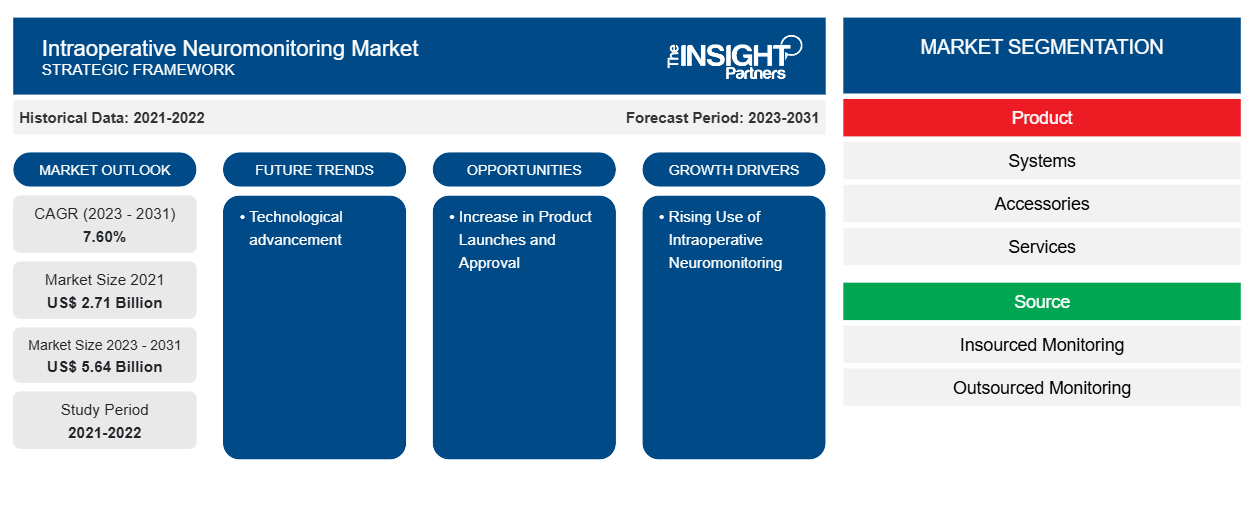
The intraoperative neuromonitoring market was valued at US$ 2.71 billion in 2021 and is expected to reach US$ 5.64 billion by 2031. The market is expected to register a CAGR of 7.60% in 2023–2031. Technological advancement will likely remain key intraoperative neuromonitoring market trends.
Read More- https://www.theinsightpartners.com/reports/intraoperative-neuromonitoring-market
Market Drivers and Growth Factors
Rising demand for IONM stems from the expansion of intricate surgeries where proximity to vital nerves heightens risks of complications like paralysis or sensory deficits. Surgeons leverage IONM for precise navigation, enabling early detection of potential issues and informed decision-making in real time. Continuous technological advancements refine monitoring capabilities, integrating seamless data streams that bolster surgical precision and outcomes.
The surge in procedures involving neural structures amplifies IONM's role, particularly as healthcare systems prioritize patient safety protocols. Growth in orthopedic spinal corrections, epilepsy surgeries, and brain tumor resections underscores the technology's versatility, positioning it as a standard in high-stakes environments. Providers benefit from reduced postoperative challenges, fostering confidence in adopting multimodal monitoring approaches.
Download PDF Copy- https://www.theinsightpartners.com/sample/TIPRE00004076
Technological Innovations Fueling Adoption
Recent product launches highlight IONM's innovative edge, such as integrated systems that combine neurological data with vital signs like heart rate and oxygenation under anesthesia. These solutions streamline workflows, offering surgeons a unified view for enhanced responsiveness during operations. Companies pioneer features that merge electrophysiological techniques, transforming IONM from supportive tool to indispensable surgical ally.
Advancements in modalities like electroencephalography (EEG), somatosensory evoked potentials (SSEPs), and motor evoked potentials (MEPs) expand application scopes, tailoring monitoring to specific surgical needs. Such developments address longstanding challenges in real-time interpretation, empowering neurophysiologists with clearer insights into neural integrity. This innovation wave not only elevates procedural safety but also opens avenues for broader integration in vascular and endocrine surgeries.
United States of America– 19 Dec 2025- The intraoperative neuromonitoring (IONM) market continues to evolve as a critical component of modern surgical practices, enhancing patient safety through real-time neural function assessment during complex procedures. Healthcare providers increasingly rely on IONM to safeguard delicate nervous system structures, driving broader adoption across neurosurgery, spinal operations, and beyond. This market-oriented analysis explores key trends, drivers, and opportunities shaping the sector's trajectory.
The intraoperative neuromonitoring market was valued at US$ 2.71 billion in 2021 and is expected to reach US$ 5.64 billion by 2031. The market is expected to register a CAGR of 7.60% in 2023–2031. Technological advancement will likely remain key intraoperative neuromonitoring market trends.
Read More- https://www.theinsightpartners.com/reports/intraoperative-neuromonitoring-market
Market Drivers and Growth Factors
Rising demand for IONM stems from the expansion of intricate surgeries where proximity to vital nerves heightens risks of complications like paralysis or sensory deficits. Surgeons leverage IONM for precise navigation, enabling early detection of potential issues and informed decision-making in real time. Continuous technological advancements refine monitoring capabilities, integrating seamless data streams that bolster surgical precision and outcomes.
The surge in procedures involving neural structures amplifies IONM's role, particularly as healthcare systems prioritize patient safety protocols. Growth in orthopedic spinal corrections, epilepsy surgeries, and brain tumor resections underscores the technology's versatility, positioning it as a standard in high-stakes environments. Providers benefit from reduced postoperative challenges, fostering confidence in adopting multimodal monitoring approaches.
Download PDF Copy- https://www.theinsightpartners.com/sample/TIPRE00004076
Technological Innovations Fueling Adoption
Recent product launches highlight IONM's innovative edge, such as integrated systems that combine neurological data with vital signs like heart rate and oxygenation under anesthesia. These solutions streamline workflows, offering surgeons a unified view for enhanced responsiveness during operations. Companies pioneer features that merge electrophysiological techniques, transforming IONM from supportive tool to indispensable surgical ally.
Advancements in modalities like electroencephalography (EEG), somatosensory evoked potentials (SSEPs), and motor evoked potentials (MEPs) expand application scopes, tailoring monitoring to specific surgical needs. Such developments address longstanding challenges in real-time interpretation, empowering neurophysiologists with clearer insights into neural integrity. This innovation wave not only elevates procedural safety but also opens avenues for broader integration in vascular and endocrine surgeries.
Intraoperative Neuromonitoring Market Advances with Technological Innovations and Rising Surgical Demands
United States of America– 19 Dec 2025- The intraoperative neuromonitoring (IONM) market continues to evolve as a critical component of modern surgical practices, enhancing patient safety through real-time neural function assessment during complex procedures. Healthcare providers increasingly rely on IONM to safeguard delicate nervous system structures, driving broader adoption across neurosurgery, spinal operations, and beyond. This market-oriented analysis explores key trends, drivers, and opportunities shaping the sector's trajectory.
The intraoperative neuromonitoring market was valued at US$ 2.71 billion in 2021 and is expected to reach US$ 5.64 billion by 2031. The market is expected to register a CAGR of 7.60% in 2023–2031. Technological advancement will likely remain key intraoperative neuromonitoring market trends.
Read More- https://www.theinsightpartners.com/reports/intraoperative-neuromonitoring-market
Market Drivers and Growth Factors
Rising demand for IONM stems from the expansion of intricate surgeries where proximity to vital nerves heightens risks of complications like paralysis or sensory deficits. Surgeons leverage IONM for precise navigation, enabling early detection of potential issues and informed decision-making in real time. Continuous technological advancements refine monitoring capabilities, integrating seamless data streams that bolster surgical precision and outcomes.
The surge in procedures involving neural structures amplifies IONM's role, particularly as healthcare systems prioritize patient safety protocols. Growth in orthopedic spinal corrections, epilepsy surgeries, and brain tumor resections underscores the technology's versatility, positioning it as a standard in high-stakes environments. Providers benefit from reduced postoperative challenges, fostering confidence in adopting multimodal monitoring approaches.
Download PDF Copy- https://www.theinsightpartners.com/sample/TIPRE00004076
Technological Innovations Fueling Adoption
Recent product launches highlight IONM's innovative edge, such as integrated systems that combine neurological data with vital signs like heart rate and oxygenation under anesthesia. These solutions streamline workflows, offering surgeons a unified view for enhanced responsiveness during operations. Companies pioneer features that merge electrophysiological techniques, transforming IONM from supportive tool to indispensable surgical ally.
Advancements in modalities like electroencephalography (EEG), somatosensory evoked potentials (SSEPs), and motor evoked potentials (MEPs) expand application scopes, tailoring monitoring to specific surgical needs. Such developments address longstanding challenges in real-time interpretation, empowering neurophysiologists with clearer insights into neural integrity. This innovation wave not only elevates procedural safety but also opens avenues for broader integration in vascular and endocrine surgeries.
0 Comentários
0 Compartilhamentos
509 Visualizações
0 Anterior

 አማርኛ
አማርኛ
 Afaan Oromoo
 English
 Arabic
 French
 Spanish
 Deutsch
 Turkish
 Dutch
Dutch
 Italiano
 Russian
 Romaian
 Portuguese (Brazil)
 Greek
Greek